A light bar that looks right on a lifted Silverado can be too wide for a stock-height SUV, while a compact bar that fits cleanly in a bumper may not throw enough light for fast off-road driving. Knowing how to choose light bar size starts with where it will mount, what you need it to illuminate, and how much light your vehicle can safely support.
The best size is not always the longest or brightest option. A properly matched LED light bar improves visibility without blocking airflow, creating unnecessary wind noise, or making installation harder than it needs to be.
Start With the Mounting Location
Before comparing light output or beam patterns, measure the usable mounting area on your vehicle. This is the fastest way to eliminate light bars that will not fit cleanly.
For roof-mounted light bars, measure the straight, level space between the mounting points or above the windshield. Account for roof racks, antennas, sunroofs, cab marker lights, and windshield trim. A bar that is technically wider than the roof can look out of place and may require custom brackets.
For bumper, grille, and lower valance installations, check both the visible opening and the depth behind it. Many modern trucks have active shutters, sensors, intercoolers, tow hooks, and factory wiring behind the front bumper. A slim single-row light bar may fit where a taller dual-row bar cannot.
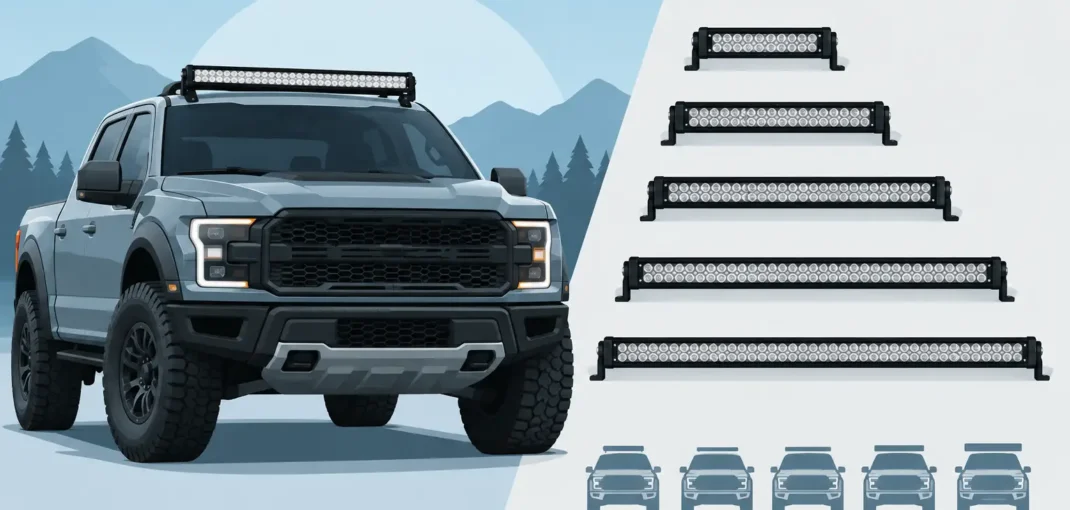
On pickups, common choices include a 20-inch bar in the lower bumper, a 30- to 40-inch bar behind the grille, and a 50-inch bar across the roof. Those are starting points, not universal fitment rules. Always measure your specific year, make, and model before ordering brackets or lighting.
How to Choose Light Bar Size for Your Driving
Light bar length affects coverage, output potential, mounting options, and appearance. Think about the speed and terrain you drive before choosing a size.
A compact 6- to 12-inch light bar works well for ditch lights, ATV applications, work areas, compact bumpers, and tight grille openings. These smaller bars are useful when you need focused supplemental light rather than a wide wall of illumination. They are also easier to conceal for a cleaner factory-style look.
A 20- to 30-inch light bar is a popular middle ground for trucks, SUVs, and Jeeps. It can provide a meaningful improvement for trails, rural roads, job sites, and recovery work without taking over the front end of the vehicle. This range often fits bumper openings and grille areas with less fabrication than a full-width bar.
A 40- to 50-inch light bar is usually chosen for roof mounting or wide front-end applications. It offers broad coverage and a strong visual upgrade, especially on full-size pickups such as a Ford F-Series, Chevrolet Silverado, or GMC Sierra. The trade-off is greater wind noise, more visible wiring, and a higher mounting position that can create hood glare if the bar is not aimed carefully.
Longer does not automatically mean better. If you mostly need light close to the vehicle on trails or around a worksite, a wide flood beam from a mid-size bar may be more useful than a 50-inch spot-heavy roof bar. If you run open desert trails or dark rural roads at higher speeds, more forward reach becomes more valuable.
Match Beam Pattern to the Size
The beam pattern matters as much as the length. Light bars are commonly offered in spot, flood, driving, and combo patterns.
A spot beam sends light farther down the road or trail. It is useful for high-speed off-road use, but it can leave the sides of the trail darker. Flood beams spread light across a wider area and are better for slow technical trails, loading areas, campsites, and work zones.
Driving beams fall between spot and flood patterns. They offer a controlled forward pattern suited to long-distance visibility. Combo bars combine spot optics in the center with flood optics at the outer sections, making them a practical choice for drivers who want both distance and side coverage from one bar.
A short light bar with a flood pattern can outperform a longer spot bar for low-speed trail use. On the other hand, a roof-mounted combo bar may be the better setup for a truck that sees open trails, ranch roads, and backcountry travel. Choose the beam for the job, then choose the bar length that fits the mounting space.
Consider Single-Row vs. Dual-Row Bars
Single-row light bars have one row of LED pods, creating a low-profile design. They are easier to fit behind grilles, inside narrow bumper openings, and beneath roof racks. Their slimmer shape can also reduce wind noise and keep the vehicle’s front end from looking overcrowded.
Dual-row light bars use two rows of LEDs. They are taller and often provide more output from a similar length, but they need more mounting depth and clearance. A dual-row bar can be a strong choice for a heavy-duty truck with a large bumper opening, while a single-row bar may be the cleaner option for a daily-driven SUV or a truck with limited grille space.
Do not choose based only on advertised lumens. Manufacturers may measure output differently, and raw lumen numbers do not tell you how the beam performs on the road. Housing quality, optics, beam pattern, weather sealing, and aiming all affect real-world visibility.
Check Clearance, Airflow, and Vehicle Features
A light bar should add function without interfering with factory equipment. Before installation, look for parking sensors, radar modules, front cameras, adaptive cruise control sensors, and grille shutters. Blocking or relocating these components can affect vehicle safety systems and may trigger warning lights.
Airflow also matters. A large bar mounted directly in front of the radiator, intercooler, or transmission cooler can restrict cooling, particularly on a truck that tows, hauls, or sees hot-weather driving. A behind-the-grille install can look sharp, but leave enough open area for air to pass through.
Roof-mounted bars need attention around door frames and windshield edges. Use vehicle-specific brackets when available, protect paint under mounting hardware, and route wiring away from moving parts. If the bar sits too far forward, reflected light can wash across the hood and reduce the visibility you were trying to gain.
Plan the Electrical Setup Before Buying
Every light bar needs a properly sized wiring harness, fuse, relay, switch, and solid ground connection. Check the light bar’s actual amperage draw and make sure your wiring kit is rated for it. For larger bars, use the manufacturer’s recommended wire gauge and avoid tapping into undersized factory circuits.
A separate fused circuit is the right approach for most auxiliary lighting. Many owners use an in-cab switch, an auxiliary switch panel, or factory upfitter switches when equipped. Keep wiring away from exhaust heat, sharp edges, steering components, and suspension travel.
If you are adding several accessories, such as a light bar, fog lights, cab lights, and work lights, calculate the total electrical load. Most modern trucks can support auxiliary lighting, but the alternator and battery still have limits. A clean installation is safer, easier to troubleshoot, and more reliable in bad weather.
Know Where You Can Use It
Most high-output LED light bars are designed for off-road, work, farm, trail, or private-property use. Laws for public-road use vary by state and local regulations. Some areas limit the number of forward-facing auxiliary lights, require covers, or prohibit certain beam colors and mounting positions.
Do not assume that a light bar is street legal because it can be installed on a daily driver. Keep it switched separately from factory headlights, aim it away from oncoming traffic, and use a cover when required. A bright bar pointed too high can create dangerous glare for other drivers and can make your own view worse in rain, snow, dust, or fog.
Choose a Size That Fits the Whole Build
The right light bar should look intentional on the vehicle. A 50-inch roof bar may suit a lifted full-size truck with off-road tires and a roof rack, while a slim 20-inch bar tucked into the bumper may better match a clean street-oriented build. Consider the finish, too. Black housings usually blend into grilles and rooflines, while amber accents can add visibility in dust or poor weather when used appropriately.
Use your vehicle measurements and driving needs as the final filter, then select a bar with the beam pattern, housing depth, and wiring requirements that match your plan. When you are ready to shop, Car and Truck Zone makes it easier to compare lighting upgrades alongside the brackets and exterior accessories that suit your vehicle.
A well-sized light bar should disappear into the build until the road, trail, or job site gets dark. That is when the right fit proves its value.